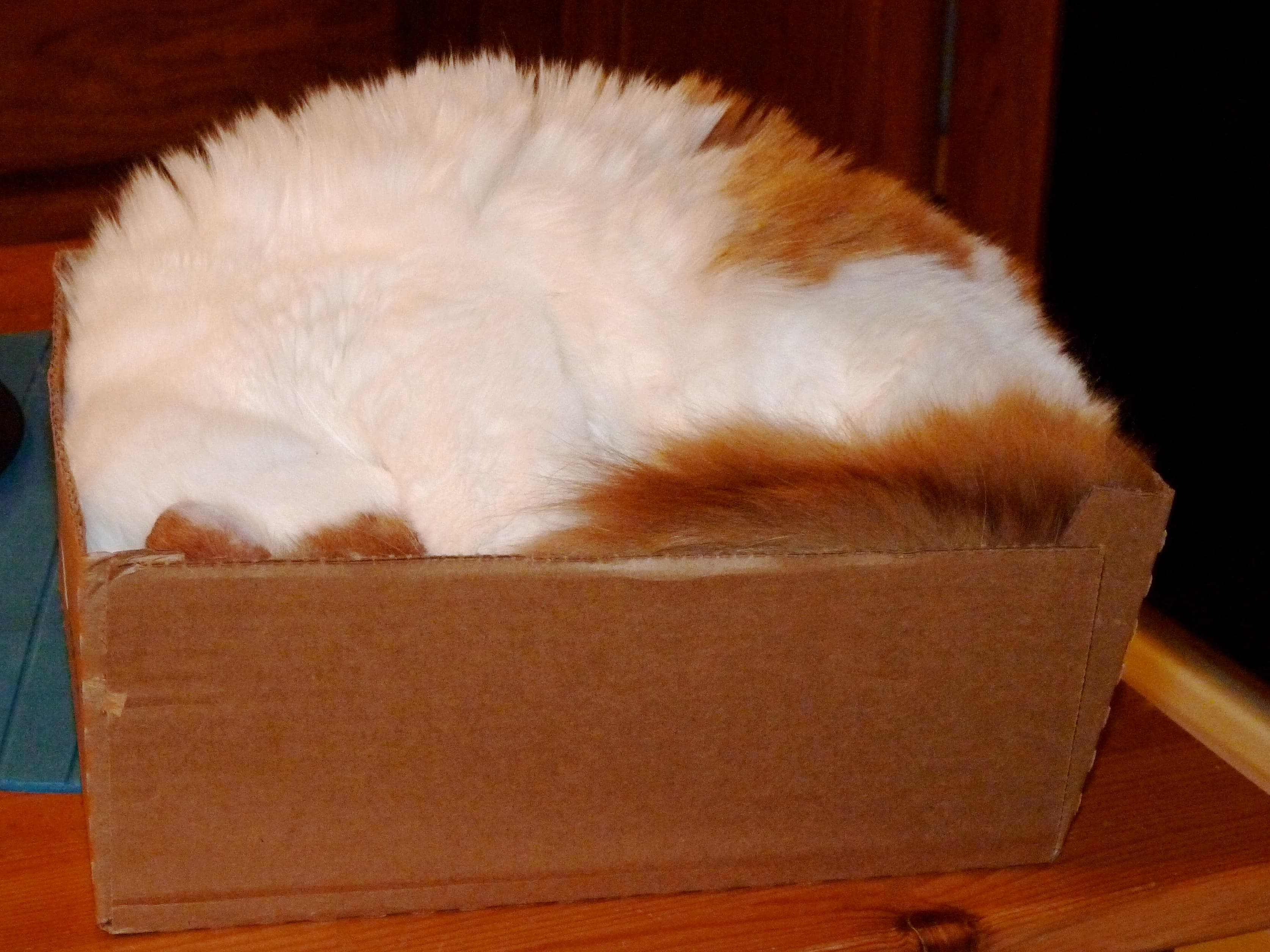
Congratulations on your expensive new cardboard box
You bought your cat a beautiful bed.
Orthopaedic foam. Tasteful fabric. Possibly a colour selected to complement the living room.
Your cat inspected it for six seconds, climbed into the delivery box and has lived there ever since.
This is not ingratitude. It is simply one of the most reliable laws of cat ownership: whatever arrives inside the box may be optional. The box itself is premium real estate.
A small room with excellent security
Cats like places where they can retreat, observe and feel protected. A cardboard box gives them walls, a defined entrance and a surprisingly effective sense of separation from the chaos around them.
Research in veterinary settings has examined whether access to hiding boxes can reduce signs of fear and stress in cats. [S1] A hospital is obviously very different from your living room, but the basic idea helps explain why enclosed spaces can be valuable resources for a cat.
To us, it is packaging.
To the cat, it is a one-bedroom apartment with excellent defensive architecture.
Boxes are wonderfully interactive
A box can be sat in, slept in, scratched, bitten, ambushed from and dramatically abandoned.
Its edges move. Its surface makes noise. A paw can disappear behind a flap and return as if this were breaking news.
Compare that with the expensive cat bed, whose main interactive feature is “being a bed”.
The cardboard box never stood a chance of losing.
The smaller the box, the greater the ambition
One of the great feline mysteries is the belief that body size is negotiable.
If three quarters of the cat fit inside, the box is apparently suitable. The remaining quarter can be dealt with through determination.
This produces the familiar sight of ears, paws and tail emerging from a container that appears to have been designed for two teacups.
Do not correct the cat. The cat has reviewed the dimensions and approved them.
There is also the comfort factor
Cardboard is soft enough to feel forgiving, insulating enough to feel cosy and disposable enough that scratching it does not create a household emergency.
A box in a quiet location can therefore combine several feline priorities at once: shelter, warmth, observation and the right to destroy part of the furniture without consequences.
That is a difficult package for a designer bed to beat.
Should you keep every box forever?
No. Unless you want your home to resemble a small fulfilment centre.
But keeping one or two clean, safe boxes in places your cat already enjoys can be a wonderfully cheap form of environmental enrichment. Remove staples, tape loops, plastic wrapping and anything unsafe to chew or swallow.
Then allow the interior designer to take over.
The lesson your cat would like you to learn
Humans are impressed by price tags.
Cats are impressed by an object that has four walls, smells interesting and arrived five minutes ago.
It may be one of their most useful contributions to philosophy: luxury is not what you paid for. Luxury is finding exactly the right box and refusing to explain yourself.
Sources
S1 — Thinking inside the box: do hiding boxes reduce the fear and stress of hospitalised cats?